Open digital sound ecosystem
We mostly think about sound processing in the exciting and artistic land of music production, but audio processing and synthesis is an essential part of our modern internet experience. The hardware we use to render audio is pretty opaque, involving almost exclusively proprietary chips from relatively obscure vendors. This issue propagates into the firmware and software stack.
Enter stage right: Free and Open Source music production, audio processing, music distribution software and hardware. Together, the people building and maintaining the open sound ecosystem bring more freedom to everyone who interacts with digital audio. They democratise music production for amateurs. They bring openness to the audio stack. They enable artists and creators to audit, control, and truly understand their tools. And they bring those who enjoy listening to music independence from Big Tech providers.
We have supported several projects in this ecosystem through the NGI Zero programmes, like the NGI Zero Commons Fund.
Open digital sound projects supported by NLnet
>> Hardware
Tiliqua a powerful, hackable, FPGA-based audio multitool
 Tiliqua aims to make FPGA-based audio and video synthesis accessible. With fully reconfigurable hardware and a rich suite of example projects built in Python (Amaranth HDL), Tiliqua allows you to experiment with synthesis techniques out of reach of embedded microcontroller-based platforms. Think extreme oversampling for alias-free audio-rate modulation, low-latency effects, video synthesis, high-speed USB audio, or emulating retro hardware.
The project's own website: https://apf.audio/modules/current/tiliqua.
Tiliqua is available in brick and mortar stores :). At Perfect Circuit in the USA and at Schneiders Laden in Germany.
TBD DSP toolkit Open hardware audio processing module
TBD DSP Toolkit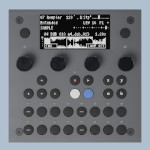 is an open-source platform for audio Digital Signal Processing (DSP) for experimentation, learning, and audio research. It brings together more than 50 high-quality generators and effects within a modular, easily extensible architecture. TBD has a flexible approach to embedded audio processing, and tries to deliver an accessible, musician-friendly environment, both in software and hardware. By uniting developer flexibility with musician usability, TBD aims to offer a resilient, open-source alternative in a landscape dominated by proprietary platforms. All software is released under GPL 3.0, and updated open hardware designs will be published in KiCad.
The project's own website: https://dadamachines.com/products/tbd-16/.
Mentions of TBD-16 in the media: Gearnews, Perfect Circuit, Synth Anatomy, and Elektronauts.
TBD-16 videos: tbd-16 teaser (Youtube), tbd-16 Sound Demo (Youtube), Trying out tbd-16 at the Superbooth booth (Youtube), SYNTH NEWS item on Superbooth 2026 section on tbd-16 (Youtube), My Favorite Synths @ Superbooth on tbd-16 (Youtube).
Noise Nugget Free and open source digital audio processing
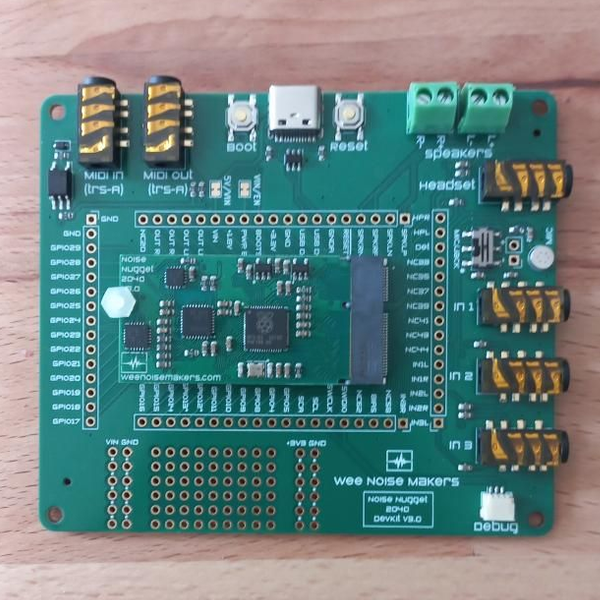 Noise Nugget is an ultra-compact development board for audio synthesis and processing, providing all the complexity of digital audio in a simple, reusable, open-source, and open-hardware module. With an emphasis on low cost, small form factor, and design for manufacturing. The end goal is to provide a complete solution (hardware and software) for anyone to discover and experiment with digital audio, while opening an easy way to transition to production of audio products in series.
The project's own website: https://weenoisemakers.com/.
>> Software
Heavy Compiler Collection Unified Digital Signal Processing and Interface Design for Audio Plugins
HVCC is a python-based dataflow audio programming language compiler that generates C/C++ code and a variety of specific framework wrappers. It leverages creative coding and the Pure Data visual programming language as a design interface for optimized and embeddable DSP code. It has found uses in different fields like procedural game audio, desktop production plugins and embedded hardware systems.
The project's own website: https://wasted-audio.github.io/hvcc/.
Zrythm A highly automated and intuitive digital audio workstation
 Zrythm is a digital audio workstation (DAW) that enables musicians and producers to create professional-quality music. Built with modern C++ using Qt/QML and JUCE, it targets electronic music workflows with advanced capabilities such as signal-based modulation and clip looping that proprietary tools have long monopolized..
The project's own website: https://www.zrythm.org.
Multisoni Modern and efficient real-time audio playback engine
Multisoni is a versatile audio engine for all creative uses. For demanding real-time uses (such as video games, VR, live installations) there is a lack of free/libre audio authoring tools to map playback and effects to trigger events and interaction parameters, suitable for industrial purposes. Multisoni is designed to meet this need: it manages many input sources - either samples or synthesis, with support for input plugins - source and effect patching, and rendering for a variety of output systems. One of its main objectives is to put creative users - sound designers, composers - on an equal footing with developer users.
The project's own website: https://lab.frogg.it/multisoni/multisoni.
>> Hosting
Faircamp Self-hostable, maintenance-free websites for audio producers
 Faircamp is a static site generator for audio producers, empowering artists, labels and everyone else working with sound to distribute their work on their own, with low resource requirements and little to no maintenance effort. You can point Faircamp to a folder hierarchy containing your audio files. Within minutes, Faircamp builds a complete website presenting your work. The resulting site requires no database, no programming, no maintenance, and is compatible with virtually every webhost on this planet.
The project's own website: https://simonrepp.com/faircamp.
Federating Mirlo Connecting artists and audiences with ActivityPub
 Mirlo provides a user-friendly space to help artists sell digital music and merch, receive financial support, manage mailing lists, and share with their supporters. The goal of federating Mirlo is to connect more artists with more supporters, towards a resilient and lively ecosystem of audio art.
The project's own website: https://mirlo.space.
PeerTube A decentralised streaming video platform
 PeerTube is a free, libre and federated video platform. Video is a very popular class of content and meanwhile accounts for a signicant share of internet traffic, but the choice of hosting has a lot of implications - if you send your viewers to some proprietary platform because you want to avoid cost, what happens after they watch your video? And who watches them watch? PeerTube allows for a federation of interconnected hosts (so more choice of videos wherever you go to see them) while containing the risk of exposing users to profiling, algorithmic pressure that favors extreme content, censorship and other negative aspects of centralised services like YouTube or Vimeo.
The project's own website: https://joinpeertube.org/.
Funkwhale ActivityPub-driven audio streaming and sharing
 Funkwhale is a free, decentralized and open-source audio streaming and sharing platform, built on top of the ActivityPub protocol. It enables users to create communities of interest around music and audio content in general, listen to their private music library or distribute their own productions on the network. Each Funkwhale pod, or server, can communicate with other pods to exchange audio content, metadata or for user interactions.
The project's own website: https://funkwhale.audio.
>> Visuals
cables.gl Creative tool for graphics and 3D content
 cables.gl is a tool which allows people to create beautiful, interactive, visual web content without knowing how to type a line of code. Your work is easily exportable at any time, so you can embed it into your website, use it an immersive VR experience, or integrate into other kinds of creative output. Cables patches can be published, shared, copied and remixed by the entire community. This allows people to constantly learn new things from each other.
The project's own website: https://cables.gl.
Kdenlive Free and Open Source Video Editor
 Kdenlive is an open source video editing application with advanced features. Besides the usual editing tools, effects and color scopes, it also has features like proxy editing, speech to text and automatic background removal. This project improves the editing experience by bringing a dope sheet to adjust the effects. Users will be able to decide which parameters to animate and how in a central place, within a single timeline. Kdenlive is the acronym for KDE Non-Linear Video Editor. It works on Linux, Windows, macOS, and BSD.
The project's own website: https://kdenlive.org.
Miru Multi-track video editing and real-time AR effects
 Miru is a new set of modular, extensible Web platform tools and components for still image and multi-track video editing and state-of-the-art, real-time AR. Using WebGL, WebAssembly, and open source, mobile-optimized machine learning models, Miru will give people on the social web the tools to edit images and apply interactive effects to recorded video without compromising on privacy and transparency. Miru aims to provide intuitive and user-friendly UIs which developers can easily integrate into their Web apps regardless of the frontend frameworks they use.
The project's own website: https://miru.media.
Acknowledgements
NGI Zero is made possible with financial support from the European Commission's Next Generation Internet programme, under the aegis of DG Communications Networks, Content and Technology.